In short
Choosing a CGI studio comes down to seven criteria: portfolio consistency (not its most beautiful image), artistic direction, the pipeline and the cost of variants, a written validation process, a quote that spells out what you own at the end, confidentiality (NDA, file security, use of AI), and the quality of the relationship. In a studio, a 20 to 30 second CGI commercial most often sits between €20,000 and €150,000, and a photorealistic still image between €600 and €2,500 once the product's digital twin is built (count on €2,000 to €8,000 for that build). The most reliable red flag: a quote far below market.
A CGI studio explaining how to choose a CGI studio. We are judge and party, let us say it upfront. So this guide is not a sales pitch: it is the grid we would want applied to us. The seven criteria, the exact questions to ask, and the answers that should make you run.
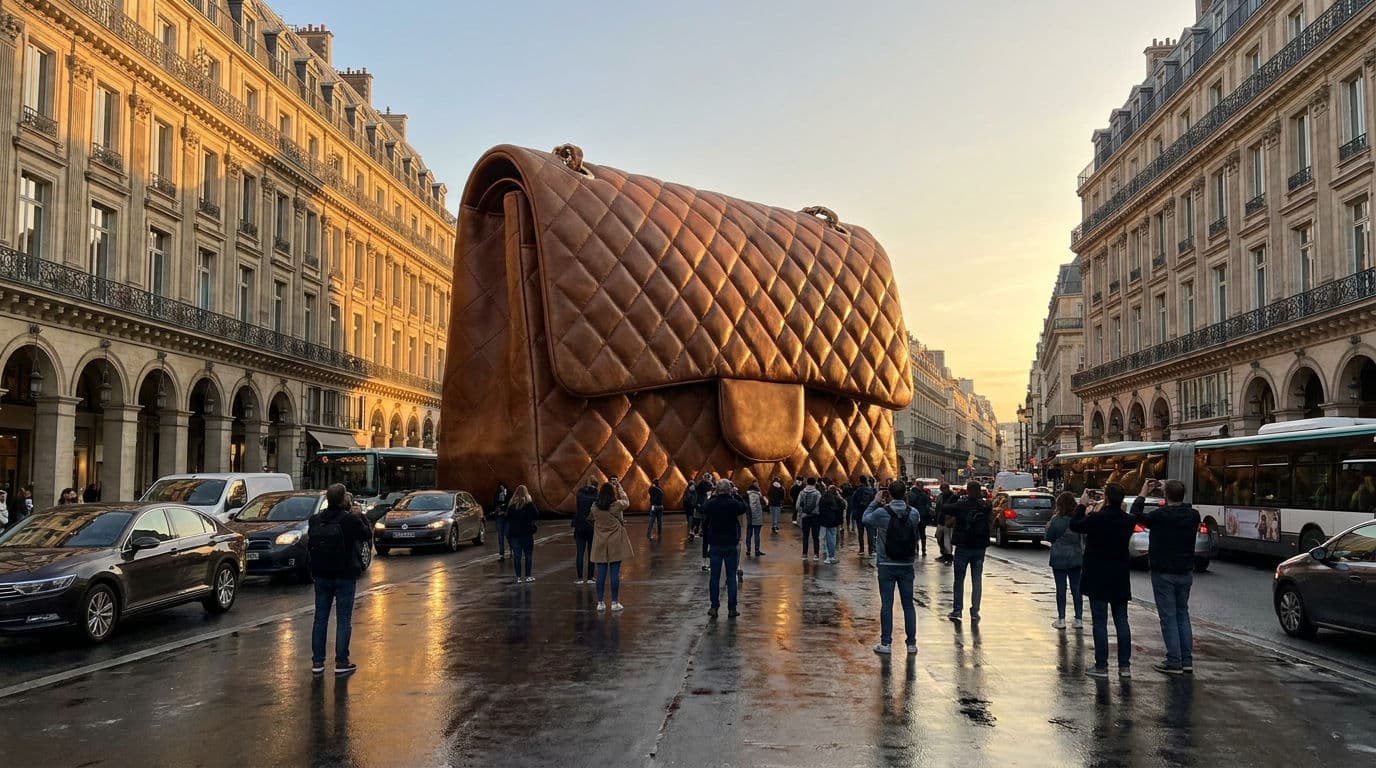
The need is very real. Jacquemus rolls giant bags through Paris, Maybelline lays a mascara over a London bus, Nike lets you configure its sneakers in 3D. Behind each of these images, there is a studio. And between the one who delivers and the one who promises, the difference only shows after the quote is signed.
Why this choice matters more than it used to
The global 3D rendering market is worth around $5.4 billion in 2025 and grows by nearly 20% a year. It is not a bubble: it is the shift of product catalogs, advertising and e-commerce toward computer-generated imagery. Shopify measured, as early as 2020, up to 94% more conversion on product pages equipped with 3D or AR. As a result, everyone calls themselves a studio. Remarkable teams have emerged. So have sellers of rough renders, at the same price.
- ◆$5.4B : the global 3D rendering market in 2025, growing by about 20% a year
- ◆+94% : more conversion on product pages with 3D/AR, according to Shopify (2020 data)
- ◆€20k to €150k : for a 20 to 30 second CGI commercial in a studio, more with heavy simulations or characters
The stakes go beyond the image budget. A failed image can be redone. A failed launch cannot. When the video has to ship on the day of the global launch, the studio that delivers ten days late did not cost you ten days: it made you miss the moment. That is why price, the favorite criterion of RFPs, is in fact the least predictive of the seven.
The 7 criteria, in the order they eliminate
1. The portfolio, read like an investigator
Everyone looks at the portfolio. Almost no one reads it. A studio's most beautiful image tells you nothing: it may have taken three weeks of retouching, or been outsourced. What informs you is consistency. Twenty images of equal level are worth more than one isolated masterpiece amid average renders.
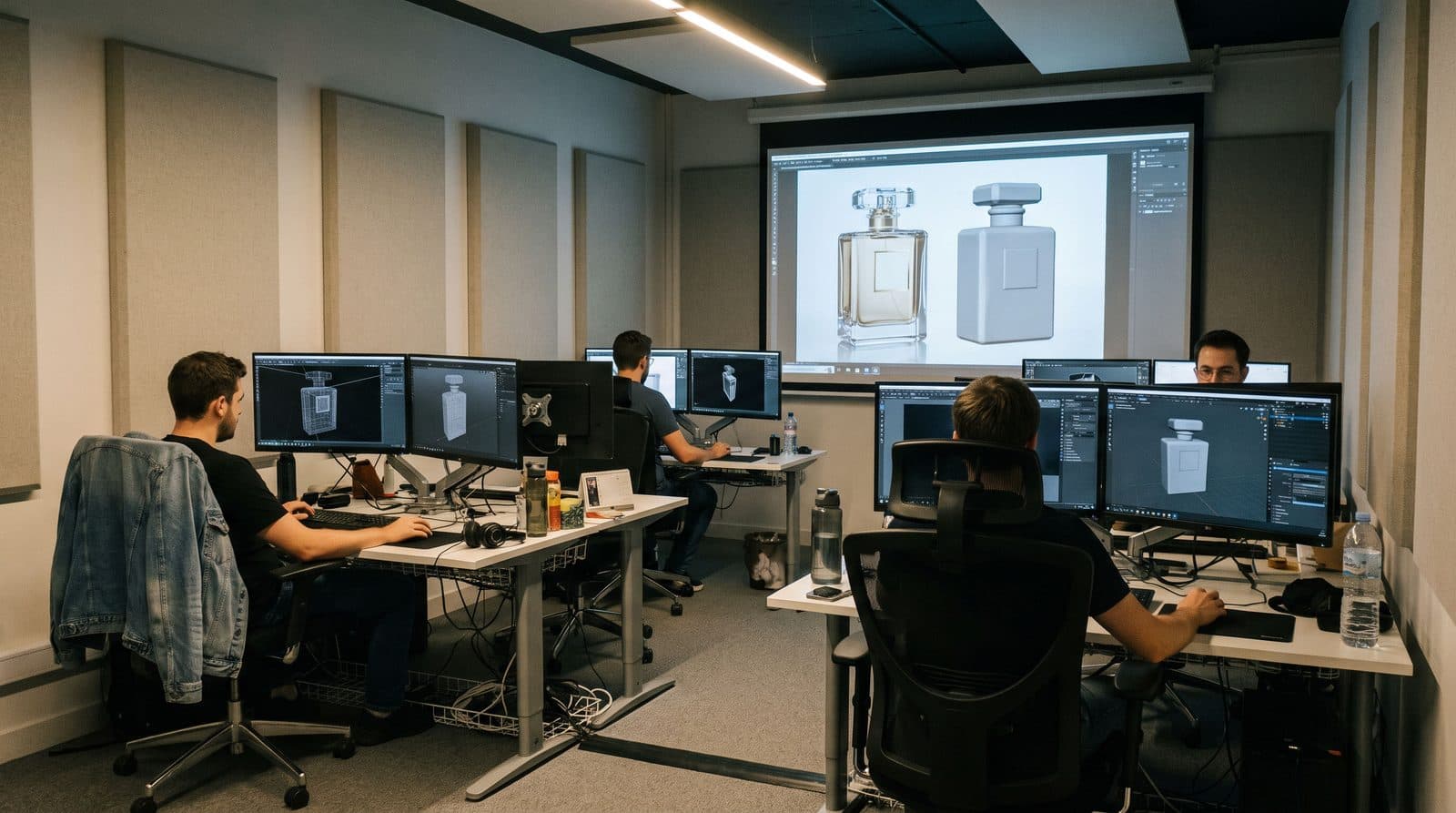
Three questions to ask. Who made these images, in house or outsourced? Can you show me a breakdown, from wireframe to final render? Have you already handled a product close to mine? A studio proud of its pipeline loves to show its backstage. The one that refuses often has a reason.

2. Artistic direction, not just execution
Technique can be bought, taste cannot. Dozens of studios can model your product cleanly. Very few can tell you why this light tells your brand's story and not another, or why the camera move planned in the brief weakens the idea. The test is simple: if the studio says yes to everything without a single question about your brand, you have found an execution vendor. Sometimes that is exactly what you need. But do not pay for it at the price of a creative partner.
3. The pipeline, or the price of the hundredth image
The true cost of CGI is not judged on the first image, but on the hundredth. A well-built 3D asset is then declined into angles, shades, formats and markets for a fraction of the initial price: in a studio, a variant is billed at €400 to €1,600, a fraction of what the original image cost, model construction included. A poorly built asset, on the other hand, is redone from scratch with each request.
Ask how the files are structured, whether materials are reusable, how the studio handles a rollout across twelve languages or thirty references. The answer tells you whether you are buying an image or a capital of images.
4. A written process, with validation stages
CGI projects that go off the rails almost always go off at the same spot: validation. No intermediate preview, unlimited back-and-forth one way and billed the other, a "final" discovered the day before the deadline. Demand a written flow: approved moodboard or styleframe, low-resolution preview, number of revisions included, deadline per stage. It is boring. It is also what separates a production from a lottery.
5. A quote that says what you own
Two quotes at the same amount can hide two opposite realities. The first includes the transfer of usage rights across all media and the delivery of source files. The second rents you one image, in a single resolution, for one year and one territory, 3D model not included. The question that settles it: at the end of the project, who owns what? The master, the production files, the product's 3D model. If the answer is vague in the quote, it will stay vague when a dispute arises.
6. Confidentiality, and a clear answer on AI
Your studio will see unreleased products, CAD files, sometimes a quarter's strategy. The NDA should be offered before you ask for it, and file security must have a concrete answer: who accesses the assets, where they are stored, what becomes of them after delivery.
And ask the 2026 question: "where do you use AI?" A serious studio answers tool by tool, stage by stage. At Digiteyes, AI works upstream: moodboards, lighting-mood tests, universe exploration in pre-production. The final deliverable remains 3D and VFX built by artists, image by image, and your files never feed a public model. It is not the only possible answer. But an evasive answer is never a good sign: a studio that cannot say where AI goes cannot say where your data goes either.
7. The relationship: a person, not a ticket
Over three or four weeks of production, you will talk to this studio more often than to some colleagues. The quality of the relationship is a production criterion, not a bonus. Who answers you, an art director or a shared inbox? How fast? In which language, on which time zone? The first exchange sets the tone: a studio that takes three days to answer a prospect will take five to answer a client.
Studio, freelancer or platform: no one is right all the time
- ◆Entry cost : 3d freelancer The lowest, platform / marketplace Low, standardized rates, integrated studio Higher
- ◆Consistency over volume : 3d freelancer Limited to one person, platform / marketplace Varies with the artists assigned, integrated studio In-house pipeline and quality control
- ◆Artistic direction : 3d freelancer Depends on the profile, platform / marketplace Rarely included, integrated studio Included, it is the core of the craft
- ◆Confidentiality : 3d freelancer To negotiate case by case, platform / marketplace Depends on the platform terms, integrated studio Established NDA and security process
- ◆Ideal for : 3d freelancer A simple, well-defined one-shot, platform / marketplace Standardized volume (simple packshots), integrated studio Campaigns, launches, demanding catalogs
A good freelancer on a simple, well-briefed packshot is often the best value on the market. A platform to roll out a hundred basic references, why not. The studio becomes without equal when three requirements stack up: consistency over time, confidentiality, and an image that must carry the brand, not just show the product.
Five red flags that never forgive
The quote 40% below market: someone will pay the difference, and it will be you, in retouching or delays. The yes to everything, without a single question about the brief. The portfolio with no breakdown and no credits. The NDA you have to ask for. And the blur around AI or subcontracting: not because either would be shameful, but because a partner who will not say how it makes your images will say even less about what went wrong.
You do not choose a studio on its most beautiful image. You choose it on its ability to remake that image a hundred times, on time, in the same light.
One last word on size. The right studio is not necessarily the biggest or the best known: it is the one whose finish level matches the real use of your images. Paying for a cinema-grade render for e-commerce thumbnails is as absurd as the reverse. At Digiteyes, we sometimes say it in a meeting: this project does not justify our finish level. A studio that knows how to tell you no on one project is often the one you can trust with the next ones.
Frequently asked questions
- ◆How much does a CGI studio project cost? In a professional studio, a 20 to 30 second CGI commercial most often sits between €20,000 and €150,000, and well beyond at large VFX studios or with heavy simulations. A photorealistic still image costs €600 to €2,500 once the product's digital twin is built (€2,000 to €8,000 depending on complexity), and a color or angle variant €400 to €1,600. The generic guides that advertise $5,000 per minute describe explainer videos, not premium advertising. Beware of extreme gaps in either direction.
- ◆CGI studio or 3D freelancer: how to decide? A freelancer excels on a one-off, simple and well-defined project. The studio prevails when you need consistency over volume, artistic direction, guaranteed deadlines or contractual confidentiality. The decisive criterion is not the quality of one image, but the ability to reproduce it at scale.
- ◆What timeline should you expect for a first project? Count on two to four weeks for an image or a series of product images, and three to five weeks for a short film, depending on complexity and the number of validations. The upstream framing phase (brief, moodboard, styleframes) is the one that protects the rest of the schedule.
- ◆How do you protect a product that has not launched yet? Through three layers: an NDA signed before any file is sent, storage restricted to the people assigned to the project, and a clause specifying the fate of files after delivery. Add an explicit question about AI: your CAD files and visuals must never be sent to tools that train on submitted data.
- ◆Should you avoid studios that use AI? No. AI saves precious time in exploration: moodboards, mood variants, framing tests. The real criterion is transparency: the studio must say where AI steps in, on which data, and what stays made by artists. At Digiteyes, it lives in pre-production; the final deliverable remains hand-crafted 3D.
Put us to the test
Ask us these seven questions, breakdown and references in hand. Digiteyes designs premium CGI, VFX and FOOH for brands and agencies, from idea to master: contact@digiteyes.fr.
Sources
- ◆Precedence Research · 3D Rendering Market Size (2025-2034) (market size and growth)
- ◆Grand View Research · 3D Rendering Market Report (2026-2033 dynamics)
- ◆Shopify · The Evolution of 3D Ecommerce (+94% conversion with 3D/AR, 2020 merchant data)
- ◆Wyzowl · Video Marketing Statistics 2026 (video usage and brands reported ROI)