In short
Yes, producing an image in CGI rather than photography sharply reduces its carbon footprint. But not for the reason everyone repeats. The biggest source of emissions in an image production is neither the studio, nor the electricity, nor the render: it's people transport, which accounts for 71.8% of the footprint of an average advertising production measured in 2026 (AdGreen data). CGI has no shoot, so no planes, no trucks, no hotel nights. It doesn't bring carbon to zero, it shifts it toward an item we can decarbonize: compute electricity. The famous -50% versus photography circulates without a solid public methodology. The real CSR argument is simpler and stronger: CGI eliminates the heaviest and hardest-to-reduce item in a production.
A CSR director asked us the question last week, roughly like this: “I'm told that moving our product visuals to 3D saves us half of our image carbon. Is that true, or is it a sales pitch?”
Fair question, and the honest answer comes in two parts. The exact figure is shaky. The direction is right. Let's see why, using what is actually measured rather than what gets repeated in meetings.
The real biggest source of emissions in a production
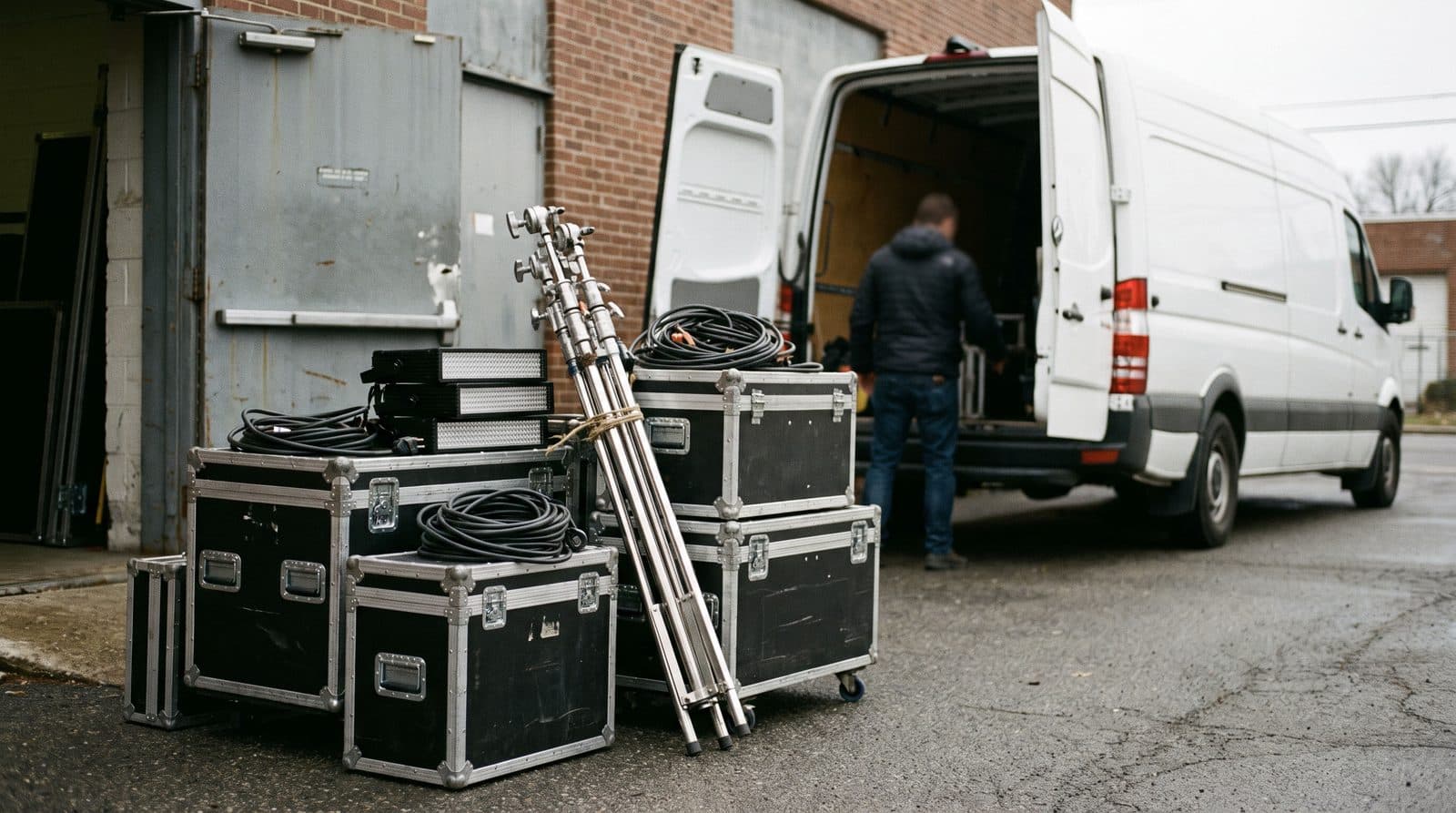
When we picture the carbon of a shoot, we think of the studio, the lights, the air conditioning. Measurement says otherwise. AdGreen, the advertising industry's carbon calculator run by the Advertising Association, aggregates the real footprints of thousands of productions every year. Across the 2,247 productions completed and measured in 2024, the biggest source of emissions, by a wide margin, is people transport: 71.8% of the average footprint. The rest is scattered: filming locations 7.4%, sets and effects 5.5%, catering 4.6%, accommodation 3.9%.
In other words, most of an image's carbon isn't the wattage on set. It's the miles. The crew travelling in, the gear on the road, the talent flying, the product sample shipped from a factory to a studio. An average production measured by AdGreen weighs 9.2 tonnes of CO2 equivalent. On large shoots, the transport share climbs higher still.
- ◆71.8% : people transport's share of the footprint of an average advertising production (AdGreen, 2024 data)
- ◆9.2 tCO2e : average footprint of a production measured in 2024 (AdGreen)
- ◆241,000 t : CO2 from transport alone tied to the Fashion Weeks each year (Carbon Trust)
That last figure puts the scale in perspective. The Carbon Trust has estimated that travel tied to the Fashion Weeks alone emits around 241,000 tonnes of CO2 a year, the equivalent of heating tens of thousands of homes. Fashion and product imagery is a travel industry before it is a pixel industry.
This is where CGI changes the game. A 3D packshot, a computed product image, a fully synthetic film: there is no shoot. So no flight, no production truck, no hotel nights for twelve people. The item that accounts for more than two thirds of a production drops to zero. This isn't an optimization detail, it's the heart of the matter.

Where the famous -50% comes from
You've probably read, somewhere, that CGI is “50% more carbon efficient” than photography. The figure has become a slogan. It deserves a close look, because your CSR team will look closely at it.
This -50% has been circulating since a 2022 report on e-commerce image production. Trace it back and you land on an estimate made by a production studio, then picked up by platforms that sell 3D product imagery. The original wording is actually cautious: “more than 50% carbon savings, counting air travel only.” That's consistent with what AdGreen says, but it isn't an independent study with a published methodology, a defined scope and third-party review. It's an order of magnitude, not a measurement.
The nuance matters, and not for the sake of splitting hairs. A poorly supported CSR figure turns against whoever puts it forward. Greenwashing now carries penalties, and a legal team prefers a solid, modest argument over a brilliant, indefensible percentage. So let's keep the -50% for what it is, a conversation marker, and rely on what holds: transport is the biggest source, CGI eliminates it, the reduction is real and structural even if its exact scale depends on each project.
A good CSR argument isn't the most flattering one. It's the one that survives the next question.
What CGI shifts, and what it doesn't eliminate
Here is the part most 3D vendors leave out, and that a serious CSR lead will demand. CGI is not carbon neutral. It has a footprint, it's just located elsewhere.
Producing a synthetic image consumes electricity: the artists' workstations, and above all the render farm, those machines that compute each shot for hours. Add to that file storage, often heavy, and increasingly the compute power of the AI used upstream. AdGreen has in fact built this into its tool: a new “data storage” category has appeared, and measurement of AI usage is on the way. No one in the industry claims that digital is free.
The difference lies in the nature of that footprint. Air travel is very hard to decarbonize: there is no clean aircraft at scale yet. Electricity, on the other hand, is already being decarbonized. A render farm powered by low-carbon electricity, or hosted in a data center that is, sees its footprint shrink. That's the real argument, and it's more honest than the -50%: CGI doesn't make carbon disappear, it shifts it from an item that's almost impossible to reduce to one we already know how to reduce.
This shift has a practical corollary. Where a shoot emits with every take, a well-built 3D asset gets reused. An entire range of shades, ten markets, three formats all come out of the same model, without a single extra mile. The footprint is paid once, at modeling, then spread across dozens of images. It's the opposite of photography, where every new variation wants its own shoot, and therefore its own travel.

The argument your CSR team can put in writing
A percentage on a slide isn't enough. What counts, in a non-financial report, is what can be measured and documented. CGI has a quiet advantage here: it produces clean data.
A synthetic image has a clean scope. No improvised trips, no last-minute hotels, no gear crossing a country because a shot moved. You know what consumed electricity, where, and how much. That makes a visual's footprint far easier to tie to a brand's scope 3 than one from a shoot spread across three locations and two time zones. The industry's tool points the same way: its simulation feature lets you compare, before you even start, a classic shoot against a virtual production, or live footage against animation. The studio is no longer the only one able to quantify the gap, the brand sees it too.
For a CSR team, then, the defensible wording isn't “our images are -50% carbon.” It's more precise, and more solid: “by producing our visuals in CGI, we eliminate the biggest source of emissions in our image production, transport, and we concentrate the remaining footprint on one item, electricity, that we can measure and decarbonize.” That sentence passes a legal review. The first one doesn't.
- ◆People transport : classic photo production Biggest item, very hard to reduce, cgi production Eliminated, no shoot
- ◆Product logistics : classic photo production Samples shipped, sometimes by air, cgi production A file, no physical object to move
- ◆Production energy : classic photo production Set, lights, production gear, cgi production Workstations and render farm
- ◆Nature of the footprint : classic photo production Mobility, nearly impossible to decarbonize today, cgi production Electricity, decarbonizable
- ◆Variations : classic photo production A new shoot per variant, cgi production Asset reuse, zero travel
- ◆CSR traceability : classic photo production Scattered emissions, hard to scope, cgi production Clean scope, tie-able to scope 3
And where does AI fit in?
There's no dodging the question in 2026: isn't generative AI, which produces an image in seconds, even leaner than CGI?
The answer requires separating two things. On a single image, a generative model consumes little at the moment of generation. But AI's real footprint is elsewhere: in training the models and in volume. You never generate one image, you generate two hundred to keep three, and every attempt costs compute. The apparent leanness of a click hides a diffuse, poorly measured consumption, which AdGreen acknowledges precisely by announcing its intent to quantify it.
At Digiteyes, we put AI where it really reduces the footprint: upstream. Exploring ten world concepts in a morning, testing lighting moods, validating an art direction on a generated moodboard, that replaces back-and-forth trips, sometimes scouting, and therefore travel. A creative decision made earlier means a shoot you don't redo and a round trip you don't take. The final deliverable, for its part, stays computed in 3D by artists, for the same reason as everywhere else: a range has to hold the same shade across thirty references, and that precision is guaranteed image by image, not by eye. AI clears the ground, 3D builds the proof. On carbon as on everything else, it's the combination that wins, not the replacement.

How to check the argument before you make it public
Before writing anything into a report, three habits keep you from a misstep.
Ask for the scope. A reduction figure without a scope means nothing. Compared to what, on which item, with or without transport, with what electricity for the render? A studio selling you a -70% without answering these questions is selling you a risk, not an argument.
Look at reuse, not just production. CGI's real gain plays out over time. A 3D asset that serves five years and fifty variations has a negligible footprint per image. A sloppy model redone for every campaign cancels the advantage. Efficiency is in the build, not just in the format.
Decarbonize the compute. Since the remaining footprint is electrical, ask the question that counts: do your render farm and your hosting run on low-carbon electricity? It's the only lever left, and it's the one that turns “less carbon” into a real result.
Frequently asked questions
- ◆Does CGI really cut an image's carbon by 50%? The direction is right, the exact figure is shaky. The -50% comes from a 2022 industry estimate, with no public third-party-reviewed methodology, that counted air travel only. What is solidly measured is that transport accounts for 71.8% of an average production's footprint (AdGreen, 2024) and that CGI, with no shoot, eliminates it. So the reduction is real and structural, but its scale depends on each project and on the electricity powering the render.
- ◆What is the biggest source of carbon on a shoot? People transport, by far. According to AdGreen 2024 data, it accounts for 71.8% of an average advertising production's footprint, ahead of filming locations (7.4%), sets and effects (5.5%), catering (4.6%) and accommodation (3.9%). Most of an image's carbon is the miles, not the wattage on set.
- ◆Is CGI carbon neutral? No, and it's important to say so. A synthetic image consumes electricity: workstations, render farm, storage, and increasingly AI compute upstream. The difference with photography lies in the nature of the footprint: air travel is very hard to decarbonize, electricity already is. CGI shifts carbon toward a reducible item.
- ◆Is generative AI greener than CGI? Not so simple. On a single image, generation consumes little, but AI's real footprint is in training the models and in the volume of attempts, often two hundred images produced to keep three. At Digiteyes, AI is used upstream, to explore and avoid travel, and the final deliverable stays computed in 3D to guarantee a range's accuracy.
- ◆How do you defend the CGI argument in a CSR report? By staying precise. Rather than a global percentage, write that CGI eliminates the biggest source of emissions in image production, transport, and concentrates the remaining footprint on electricity, which is measurable and decarbonizable. Always ask for the figure's scope, value asset reuse, and check that the render runs on low-carbon electricity. A modest, documented argument passes a legal review; a brilliant figure with no methodology doesn't.
Want to quantify the footprint of your visuals?
Digiteyes creates packshots and premium CGI for demanding brands and agencies, from idea to master. Tell us about your catalog and your CSR goals, and we'll help you frame the argument and document it: contact@digiteyes.fr.
Sources
- ◆AdGreen (Advertising Association) · Annual Review 2024 (people transport 71.8% of the average footprint, 9.2 tCO2e per production, 2,247 productions measured, data storage category and AI measurement forthcoming)
- ◆Carbon Trust · estimate of transport emissions tied to the Fashion Weeks (around 241,000 tonnes of CO2 per year)
- ◆Coresight Research · Innovator Intelligence, e-commerce image production, 2022 (origin of the “more than 50% carbon savings, air travel only” benchmark, given as an industry estimate)
- ◆National Retail Federation · data on e-commerce product returns (context for 3D's logistics gain)